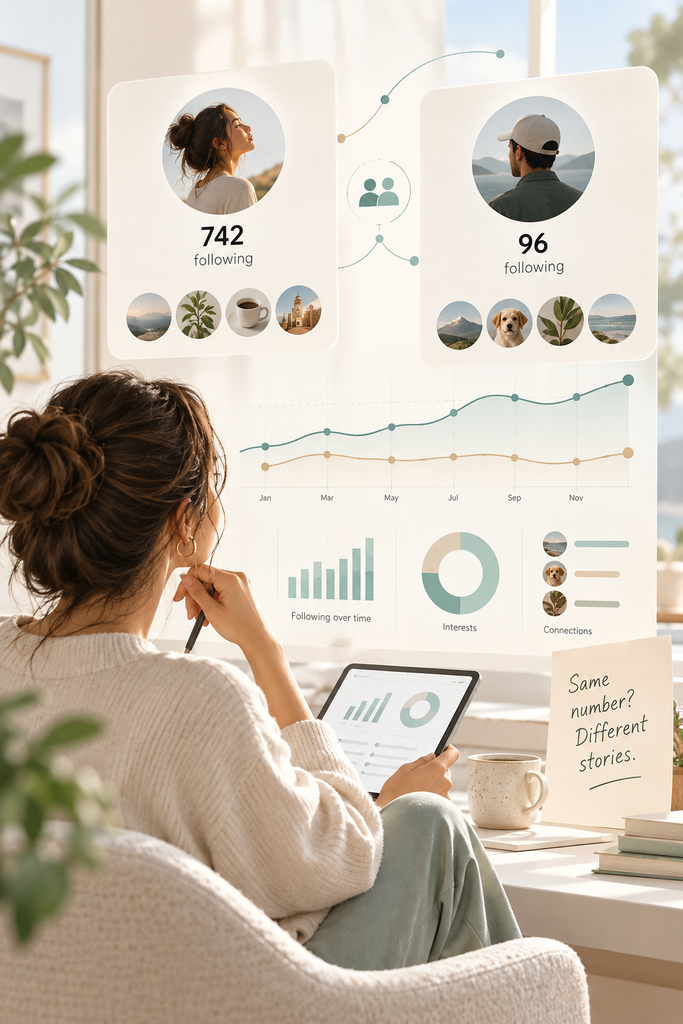
A person follows 742 accounts on Instagram. Another follows 96. At first glance, the difference seems enormous. One might be constantly discovering new people; the other appears far more selective. But those numbers leave out something rather important: neither tells us what the person actually does on Instagram.
The first account could belong to someone who followed hundreds of people in college and never bothered cleaning up the list. The second could belong to someone who opens Instagram every morning and spends an hour watching recommended videos.
That’s the trouble with following statistics. They’re easy to collect and surprisingly easy to misunderstand. An Instagram following viewer can help organize available following information, particularly when comparing an account’s connections over time. But before attaching meaning to the results, it’s worth looking at what we know about Instagram’s audience and what the platform actually records.
The Numbers Behind Instagram’s Audience
Pew Research Center’s Americans’ Social Media Use 2025 offers a useful picture of the platform’s reach. Based on a survey of 5,022 U.S. adults conducted between February and June 2025, the study found that 50% reported using Instagram. In 2021, that figure was 40%.
The differences between age groups are substantial.
| Age | Percentage using Instagram |
| 18–29 | 80% |
| 30–49 | 62% |
| 50–64 | 40% |
| 65 and older | 19% |
Source: Pew Research Center, Americans’ Social Media Use 2025. Percentages refer to U.S. adults within each age group.
There is also an 11-percentage-point difference between women and men: 55% of women reported using Instagram, compared with 44% of men.
These figures tell us who uses the platform, but they don’t tell us how people manage their Following lists. Pew didn’t measure how many accounts the average user follows or how frequently those connections change. That is a separate research question, and it requires a different kind of data.
A Following Count Is Only a Snapshot
Imagine opening a public profile and seeing that it follows 580 accounts. You return two weeks later, and the number has climbed to 612. Something has changed, certainly. What happened between those two visits is less obvious.
The increase of 32 represents the difference between two totals. The person might have followed exactly 32 accounts. Equally, they might have followed 50 and unfollowed 18. Both activities produce the same result.
This is where an Instagram following viewer that preserves dated records becomes more useful than simply checking the number beneath a profile picture. Comparing complete lists can reveal which accounts have appeared or disappeared between observations. There is a limitation even then. A follow made and reversed between two checks may never appear in either record. The point isn’t that following counts are unreliable. They’re perfectly useful for measuring totals. They just aren’t detailed activity histories.
Why the First Name on a Following List Doesn’t Tell You Much
One persistent Instagram myth is that the accounts at the top of someone’s Following list are the people they followed most recently. Instagram doesn’t give visitors that information. On your own profile, you can sort the accounts you follow by date, choosing the newest or oldest first. Open another person’s Following list, and those sorting controls aren’t available.
Independent observations published in September 2026 found that the order displayed to visitors wasn’t chronological. Instagram hasn’t published a complete explanation of how it ranks those lists.
For an Instagram following viewer, this creates an important distinction between displaying a list and identifying a recent follow. A username appearing near the top doesn’t establish when the connection was made. To identify a newly visible account, you need an earlier record for comparison. That sounds less exciting than the promise of an instant activity timeline. It’s also a much more defensible way to interpret the information.
What People’s Following Lists Say About Their Interests
Someone might follow a restaurant after enjoying dinner there, keep up with an artist whose prints they bought once, or subscribe to a university account long after graduating. Other connections may have been made almost accidentally.
A fashion student following 40 clothing labels doesn’t necessarily buy from those brands. A person following professional athletes may rarely watch sports.
For researchers, the distinction matters. Public following connections can help describe the kinds of accounts associated with a profile. They don’t measure attention or establish personal relationships.
Business accounts offer a particularly interesting example. A local coffee shop might follow nearby bakeries, suppliers, and community organizations. Those connections suggest a professional environment worth examining, but they aren’t proof of partnerships.
An Instagram following viewer can make those visible networks easier to examine. The interpretation still requires context that usernames alone don’t provide.
The Problem With Researching Activity After the Fact
Suppose you wanted to find out how a public account’s Following list changed over the summer. It’s now October, and you have only today’s list. You can’t reconstruct every addition and removal from the current information. A proper comparison needs at least two complete records taken at different times. More frequent records can narrow the interval in which a change occurred, although they won’t necessarily establish the precise time of every action.
For example, a username appearing in Wednesday’s record but missing from Tuesday’s can be described as newly observed on Wednesday. That doesn’t prove it was followed on Wednesday morning. This may sound like a minor wording difference, but it separates an observation from a guess. Researchers working with an Instagram following viewer should also record missing data. If the service fails to retrieve a list one day, the next successful observation shouldn’t be presented as a complete daily history.
What the Published Research Leaves Unanswered
We have reliable figures on Instagram adoption. Pew Research Center can tell us how usage differs across age groups and other demographic categories. What we don’t have from that survey is a typical weekly follow count, an average number of unfollows, or a representative breakdown of how people maintain their lists.
Those details would require account-level research collected over time, ideally with a clearly described sample and consistent methods. Third-party tracking data can be useful for examining particular public accounts. It doesn’t automatically describe Instagram users generally. That distinction is easy to lose when statistics from unrelated sources are placed in the same report. A national survey about platform usage and a record of 50 public accounts answer entirely different questions.
The Finding Worth Remembering
Instagram’s Following lists look simple because the interface reduces everything to names and numbers. Researching them properly is less simple. A count tells you how many accounts appear in a person’s Following total. Comparing dated lists can show changes between observations. Neither automatically explains the personal reasons behind those connections.
An Instagram following viewer can be useful for organizing this information, especially when looking at publicly available account activity over time. But the strongest conclusions are often the modest ones: a number increased, an account appeared in a later record, or a connection was no longer visible. The larger story of what someone finds interesting, whom they communicate with, or how they spend their time on Instagram isn’t contained in a Following list. Those numbers are one small part of it.